What is the Section 199 Deduction?

The Section 199 deduction (also referred to as the domestic manufacturing deduction, U.S. production activities deduction, and domestic production deduction) is a tax break for businesses that perform domestic manufacturing and certain other production activities. It was established by the American Jobs Creation Act of 2004 in an effort to ease the tax burden of domestic manufacturers and as a result, make the investment in domestic manufacturing facilities more advantageous.

What activities are eligible for the Section 199 deduction?

Per Section 199, domestic production gross receipts (DPGR) can be derived from the following qualifying production activities as long as they are conducted in whole or in significant part within the U.S.:

  • The manufacture, production, growth, or extraction by the taxpayer of tangible personal property. This encompasses all tangible personal property (except land and building), computer software, and sound recordings.
  • The production of qualified film
  • The production of electricity, natural gas, or water
  • The construction of real property
  • The services of architecture/engineering

DPGR resulting from the property produced must be owned by the producer taking the deduction (i.e. the production of property that is owned and under contract by someone else would generally not be eligible).

How is the Section 199 deduction calculated?
The deduction is limited to the income produced by the above qualifying activities. Income from qualified production activities is calculated as domestic production gross receipts (DPGR) less cost of goods sold and other expenses that are directly allocable to the production of DPGR. Income and expenses that are not directly related to qualifying activities will need to be backed out of the calculation of qualified production activity income. After the lesser of the DPGR or taxable income is multiplied by the applicable percentage (9% for 2010), the deduction is further limited to 50% of Form W-2 wages allocable to DPGR.

The Section 199 deduction is allowed for both regular and alternative minimum tax for individuals, C corporations, farming cooperatives, estates, trusts, and their beneficiaries. The deduction is also allowed at the partner, member, and owner level for a partnership, LLC, and S corporations, respectively. Businesses should also be aware that the Section 199 deduction does not always apply at the state level. As of the beginning of 2010, 22 states (including Indiana) have departed from the federal deduction.

The following are some examples of how the Section 199 deduction would be calculated in certain circumstances:

Example #1: For the year ended December 31, 2010, Kim”s Manufacturing Company (a C-Corp) had taxable income, all from qualifying manufacturing activities, of $1 million and paid $100,000 in W-2 wages.
Example #1 Solution: Kim will be entitled to a Section 199 deduction of $50,000 due to the 50% limit of W-2 wages. If the W-2 wages had been greater than $180,000, the deduction would have been $90,000 [$1 million X 9%].

Example #2: Same facts as #1 ($180k W-2 wages), except Kim’s Manufacturing Company is a S-Corp, with Kim owning 60% and Choi owning 40%.
Example #2 Solution: The deduction passes through to the shareholders, with Kim receiving $54,000 and Choi receiving $36,000 of the deduction.

Example #3: Same facts as #2, except that Kim takes a $108,000 distribution and Choi takes a $72,000 distribution. No W-2 wages are paid.
Example #3 Solution: A Section 199 deduction can’t be taken because W-2 wages were not paid.

What are some specific applications of the Section 199 deduction to the Manufacturing Industry?

Qualified production property (QPP) includes all tangible personal property, except land and buildings, and includes computer software and sound recordings. Qualified manufacturing activities will include those which, manufacture, produce, develop, improve, install, grow, extract and/or create the qualifying production property. Even those processes that use scrap, salvages, or junk material (instead of new or raw material), may be eligible. Such produced material will be eligible if it is processed, manipulated, refined, or altered such that the material’s form is changed or the material is combined/assembled into two or more articles or materials. Furthermore, manufacturing components that will later be used by another party for manufacturing or product activities will be considered eligible.

Below are some of the other examples

The Suburban Family in Westchester

A married couple in a New York suburb has estimated state income tax of $17,290; their annual mortgage interest deduction is $14,000; and they pay property tax of $13,750—about the same amount they donate to charity.
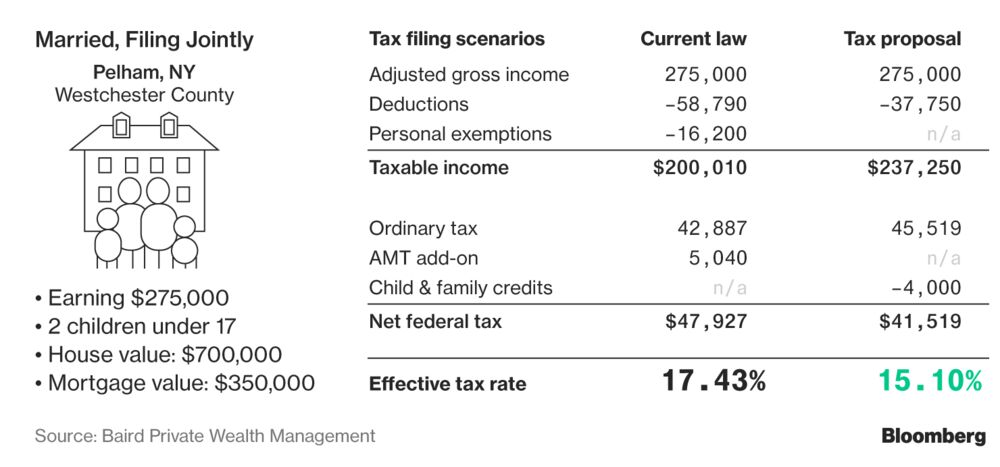
While the bill takes a bite out of this family’s deductions and exemptions, they would benefit from enhanced child tax credits and avoiding the alternative minimum tax, or AMT. (The bill would raise the thresholds at which the AMT applies—until 2026.)

Single in Manhattan

This New York renter pays estimated state income tax of $8,148 and gives about $6,500 to charity.
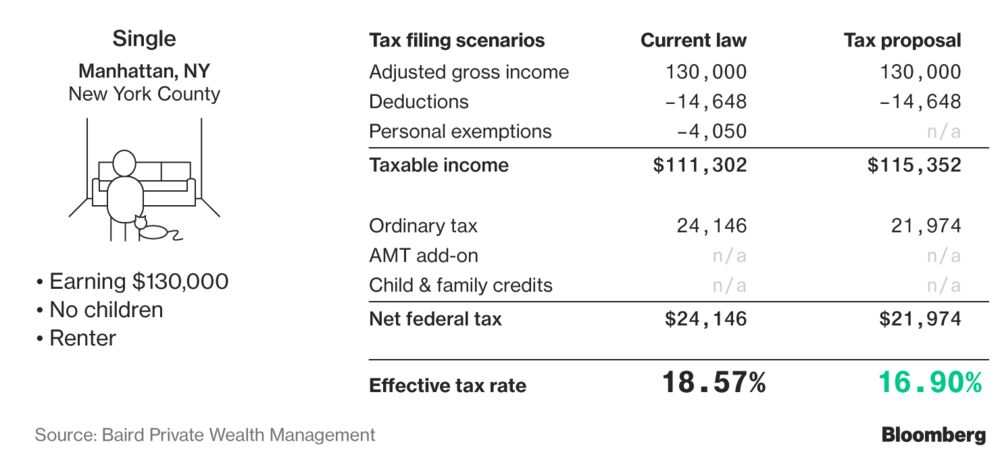
The final tax legislation is more generous to this taxpayer than the bills that originally passed the House and Senate. That’s because it permits the deduction of state and local income taxes up to $10,000. The original proposals scrapped the income tax deduction entirely and allowed only a $10,000 deduction for property taxes, which this renter doesn’t pay.

The Multimillionaires in New York

These Manhattan residents have a jumbo mortgage (at an assumed 4 percent interest rate) and take a $40,000 deduction on mortgage interest; pay property taxes of $96,250 and state income tax of $135,360; and make annual charitable contributions totaling $100,000.
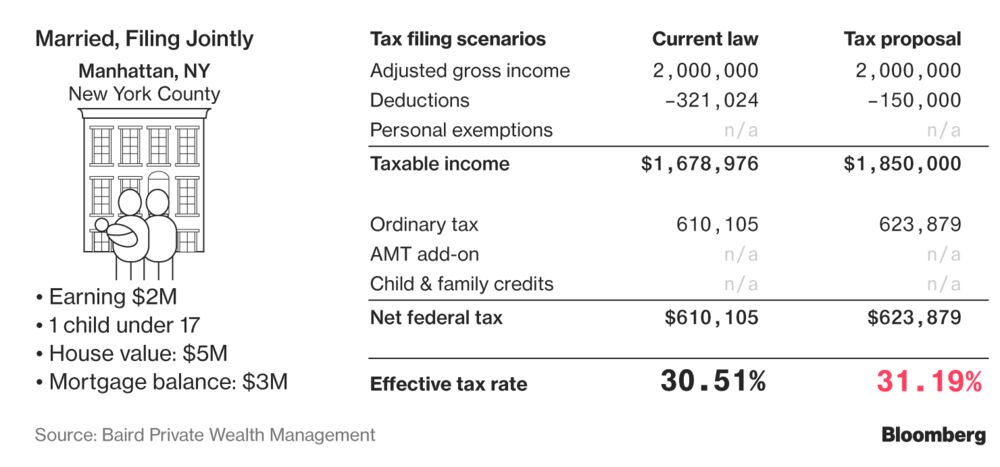
They will pay a bit more next year because they would lose key deductions, especially the ability to put down more than $10,000 in state and local taxes. That offsets a drop in the top marginal tax rate, from 39.6 percent to 37 percent. (The “marginal rate,” the rate paid on any extra dollar earned, is different from the “effective tax rate,” which is the overall, blended rate you pay as different tax rates are levied on your income at different thresholds.)

City taxes for these Manhattan dwellers would work out to almost 4 percent. Combine that with the top federal rate and top state rate, and you get a marginal rate approaching 50 percent.

The Second-Home Scenario in California

A married couple has a primary residence in Malibu, California, and a second home in Lake Tahoe. The property tax on the Malibu home is $15,860, and they pay $4,896 on their second home; they deduct a total of $40,000 in mortgage interest for the two homes; and they give $50,000 to charity.
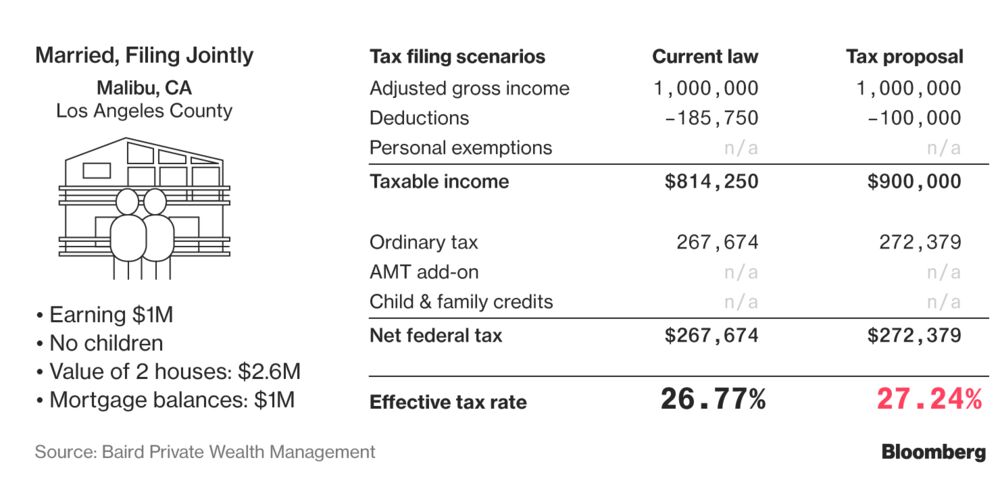
This couple would lose almost $86,000 in deductions under the tax bill. Nonetheless, other changes—especially the drop in the top tax rate—means their effective tax rate creeps up by only 0.5 percentage points.


#TAX#REFORM

Following are several key tax reform provisions discussed behind closed doors in conference:

#Individual #tax #cuts: In the end, GOP leaders settled on a seven-rate structure, the same as exists now, with lower rates and revised bracket amounts. Ultimately, the top rate was cut from its current level of 39.6% to 37%, as opposed to the 38.5% rate that appeared in the Senate Bill.

#Standard#deduction and personal #exemptions: Along with the individual rate cuts, the standard deduction is effectively doubled to $12,000 for single filers and $24,000 for joint filers. Personal exemptions are completely eliminated.

#Child #tax #Credit: Currently, the child tax credit is only $1,000 per qualified child, but the new law increases it to $2,000, with $1,400 being refundable. This was a sticking point for Senator Marco Rubio (R-FL), who insisted on more flexibility for low-income families.

#Mortgage#interest#deduction: Based on a late change, the deduction for mortgage interest is limited to interest paid on up to $750,000 of acquisition debt, down from its current limit of $1 million. The Senate bill had left the $1 million limit untouched while the House bill imposed a $500,000 threshold.

#Corporate#tax#rates: The top tax rate for corporations drops from 35% to 21%. Both the House and Senate bills featured a top 20% rate, which was endorsed by the White House. The lower rate would take effect in 2018—not 2019 as the Senate bill provided.

Individual AMT: The individual alternative minimum tax (AMT) remains, but the threshold would be tweaked to exclude any taxpayer with income under $500,000 or family below $1 million.

Corporate #AMT: The corporate AMT, which was preserved by the Senate bill, is repealed. This was a critical concession to businesses eligible for the research credit.

#Medical#deductions: Under current law, only medical expenses in excess of 10% adjusted gross income (AGI) can be deducted, up from the previous level of 7.5% of AGI. The final bill reportedly keeps the medical deduction and restores the 7.5%-of-AGI threshold, but only for 2018.

#State and #local#taxes: In another late compromise, a maximum deduction of $10,000 is now reportedly available to taxpayers state and local property taxes or state and local income taxes or sales taxes or a combination. But these concessions aren’t likely to appease taxpayers in states with high taxes.

#Estate#tax#exemption: For 2018, the estate tax exemption can shelter up to $5.6 million of assets from estate tax. This generous exclusion is effectively doubled to $11 million.

#Health#insurance#mandate: The insurance requirement under the Affordable Care Act (ACA), the law known as Obamacare, is abolished.

Finally, the proposed legislation retains other tax breaks that were on the chopping, such as deductions for student loan interest and tax-free private activity bonds used by local governments to build hospitals. The two chambers of Congress are expected to vote on the measure early next week.


From CPA Pracice Advisor

#TAX #REFORM – At Glance

What deductions can I claim under the Senate bill that just passed?

The Senate bill does away with federal deductions for state and local income and sales taxes but allows deductions of up to $10,000 in local property taxes. The legislation originally eliminated federal deduction for all state and local taxes, but the property tax exemption was later added at the insistence of Sen. Susan Collins, R-Maine, who said she was “delighted” about the change.

What about personal deductions?

Like the House bill, the Senate bill nearly doubles the standard deduction level to $12,000 for individuals (up from $6,350) and $24,000 for couples (up from $12,700).

Any other deductions I could claim?

The Senate bill retains the current limit for the home mortgage interest deduction to interest paid on the first $1 million of the loan. (The House bill reduces the limit to $500,000 for new home purchases.) The Senate version also preserves the deduction for medical expenses not covered by insurance (the House bill does not), but ends deductions for moving expenses and tax preparation.

Why does the Senate bill allow deducting medical expenses not covered by insurance?

Because the Senate bill also repeals ObamaCare’s individual mandate, while the House bill does not. If ObamaCare’s mandate is repealed, thousands of people are expected to drop their health insurance, raising the cost for those who decide to keep it.

And the personal exemption?

The Senate and House bills both eliminate the $4,050 personal tax exemption.

Will the tax brackets change at all?

The Senate bill keeps seven tax brackets but reduces them to 10, 12, 22, 24, 32, 35 and 38.5 percent. (The current brackets are 10, 15, 25, 28, 33, 35, and 39.6 percent.) The House measure condenses seven brackets to four: 12, 25, 35 and 39.6 percent.

I own a small business. What would this mean for me?

The Senate bill allows owners of so-called “pass-through” businesses (that is, businesses that aren’t incorporated) to deduct 23 percent of their earnings, and then pay at their personal income tax rate on the remainder. This issue was a key concern of Sens. Ron Johnson, R-Wis., and Steve Daines, R-Mont., both of whom announced this week that they would support the bill.

What about corporate tax rates?

Like the House bill, the Senate bill cuts the current 35 percent rate to 20 percent, but the Senate bill calls for a one-year delay in dropping the rate.

When will tax reform take effect?

President Trump and congressional Republicans have vowed to make tax reform law before the end of the year. If that happens, most of the provisions would come into force on Jan. 1.

Will tax reform affect my returns for this year?

The changes will not have any impact on your taxes for 2017, which are due to the IRS by April 17, 2018 (you get an extra 48 hours to file because the traditional April 15 due date falls on a Sunday).

So when will the differences in the bills be hashed out?

The House will vote on a motion to go to conference on the tax bills on Monday evening. The Senate is expected to vote on a similar measure soon after. Congress is scheduled to adjourn for its Christmas break on Dec. 15, but House Speaker Paul Ryan has said he will keep the House in session beyond that date if necessary to get tax reform passed.

Five Things to Remember about #Hobby #Income and #Expenses


From scrapbooking to glass blowing, many Americans enjoy hobbies that are also a source of income. A taxpayer must report income on their tax return even if it is made from a hobby.

However, the rules for how to report the income and expenses depend on whether the activity is a hobby or a business. There are special rules and limits for deductions taxpayers can claim for hobbies. Here are five things to consider:

  • Determine if the activity is a business or a hobby. If someone has a business, they operate the business to make a profit. In contrast, people engage in a hobby for sport or recreation, not to make a profit. Taxpayers should consider nine factors when determining whether their activity is a business or a hobby, and base their determination on all the facts and circumstances of their activity. For more about ‘not-for-profit’ rules, see Publication 535, Business Expenses.
  • Allowable hobby deductions. Taxpayers can usually deduct ordinary and necessary hobby expenses within certain limits:
    • Ordinary expense is common and accepted for the activity.
    • Necessary expense is appropriate for the activity.
  • Limits on hobby expenses.  Taxpayers can generally only deduct hobby expenses up to the amount of hobby income. If hobby expenses are more than its income, taxpayers have a loss from the activity. However, a hobby loss can’t be deducted from other income.
  • How to deduct hobby expenses.  Taxpayers must itemize deductions on their tax return to deduct hobby expenses. Expenses may fall into three types of deductions, and special rules apply to each type. See Publication 535 for the rules about how to claim them on Schedule A, Itemized Deductions.
  • Use IRS Free File.  Hobby rules can be complex, and IRS Free Filecan make filing a tax return easier.

Additional IRS Resources:

Share this tip on social media — #IRSTaxTip: Five Things to Remember about Hobby Income and Expenses.  https://go.usa.gov/xnKZr

Back to Top

Tax Bills Keep Real Estate Exchanges

House Tax Bill Repeals Personal Property Exchanges, but Preserves Real Property Exchanges

On November 2, 2017, Kevin Brady, Chairman of the Committee on Ways and Means, released the “Tax Cuts and Jobs Act” (H.R. 1). The House tax bill proposes eliminating personal property 1031 exchanges after the end of 2017. In addition, the House tax bill proposes a transition period for any personal property exchanges started before December 31, 2017. The House tax bill proposes full expensing for most personal property purchases for five years.

There are no proposed changes to 1031 exchanges of real property in the House tax bill.

Senate Tax Bill Repeals Personal Property Exchanges, but Preserves Real Property Exchanges

On November 9, 2017, the U.S. Senate Committee on Finance released the “Description of the Chairman’s Mark of the Tax Cut and Jobs Act.” Under the heading “Like-Kind Exchanges of Real Property” is the description of the proposal. The proposal modifies the provision providing for nonrecognition of gain in the case of like-kind exchanges by limiting its application to real property that is not held primarily for sale. The proposal generally applies to exchanges completed after December 31, 2017. However, an exception is provided for any exchange if the property disposed of by the taxpayer in the exchange is disposed of on or before December 31, 2017

, or the property received by the taxpayer in the exchange is received on or before such date taxpayer in the exchange is received on or before such date. The Senate tax bill proposes full expensing for most personal property purchases for five years.

There are no proposed changes to 1031 exchanges of real property in the Senate tax bill.

The Joint Committee on Taxation (JCT) projects these changes to Section 1031 will increase tax revenues by $30.5 billion between 2018-2027.

Blog at WordPress.com.

Up ↑